
A root canal works from the top of the tooth inward. An apicoectomy works from the root tip outward — under a microscope.
In most cases a root canal resolves the infection completely. But root anatomy is complex — and some infections persist at the root tip in areas that instruments cannot reliably reach from above. That is where an apicoectomy picks up.
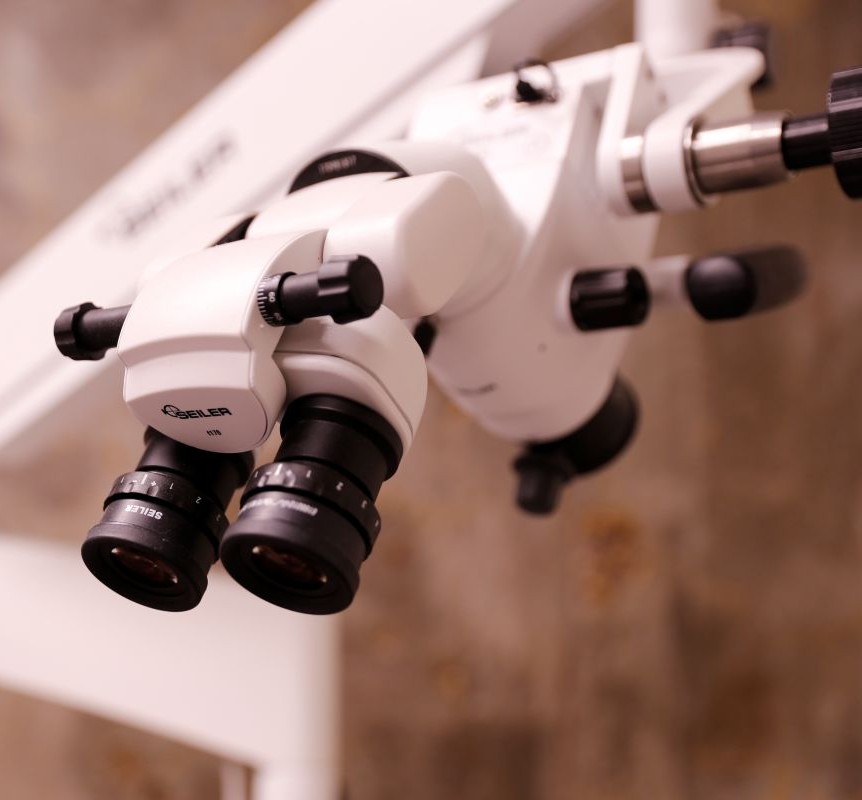
Performed under 10 to 16× magnification with a surgical microscope, the procedure allows a level of precision that simply was not possible in endodontics a generation ago. We see clearly. We remove only what needs to be removed.
Common reasons an apicoectomy becomes necessary:
- Infection persisting at the root tip after root canal treatment — often in anatomy that instruments cannot reach from above
- Calcified canals that cannot be safely navigated non-surgically
- A fracture or crack only visible under magnification at the root end
- Cysts or damaged bone around the root that require direct access to resolve
- Hidden canals that standard X-rays do not show but continue to cause infection
You are awake. You are numb. The whole thing takes under 90 minutes.
An apicoectomy is an outpatient procedure. You come in, have it done, and go home the same day. Here is what actually happens — without the clinical language.
- 01 Local anaesthesia — you will not feel it The area is fully numbed before anything begins. You are awake throughout, just as you would be for a root canal. Most patients are surprised by how little they feel.
- 02 A small incision in the gum We make a small opening in the gum tissue near the affected tooth to access the root tip and the surrounding bone. The incision is precisely placed to minimise disruption and heal cleanly.
- 03 Removing the infected tissue and root tip The inflamed or infected tissue around the root tip is removed. The last few millimetres of the root — where infection most commonly persists — are also removed. This is performed under microscope magnification, which allows precision that is simply not possible with the naked eye.
- 04 Sealing the root end A small filling is placed in the root end to seal it against reinfection. The material used is biocompatible — designed to support rather than interfere with the healing process.
- 05 Suturing and recovery The gum tissue is sutured closed. Stitches are removed at a follow-up visit a few days later. The bone around the root heals naturally over the following months, restoring full function.
Surgery sounds serious. Extraction is permanent.
Patients who hear "you need surgery" sometimes ask whether extraction would be simpler. In most cases, it would not be. Extracting the tooth removes the immediate problem — but it starts a longer chain: bone loss at the extraction site, shifting of neighbouring teeth, and the cost and recovery of an implant if you want to replace it.
An apicoectomy is a 30–90-minute outpatient procedure with a few days of recovery. Most patients return to normal activities the following day. The tooth is preserved, the bone heals naturally, and the result is indistinguishable from a healthy tooth.
You can always extract a tooth. You cannot un-extract one. If surgery can save it, we will tell you honestly — and so will we if it cannot.
"Seven months later, I have had no problems since the surgery and I can't even tell anything was done outside of the non-existent discomfort I once had. My smile is intact and I owe much of it to Dr. O'Callaghan and her team."
What patients ask before they agree to surgery.
- Does having an apicoectomy mean my root canal failed?
- Not in the way most patients think. A root canal addresses the infection from the top of the tooth inward. An apicoectomy addresses the root tip from the outside — the part of the anatomy that instruments sometimes cannot fully reach. One is not a correction of the other. Together, they give the tooth the best possible chance.
- Is an apicoectomy more painful than a root canal?
- Most patients report that recovery is more noticeable than a root canal — some swelling and tenderness for two to three days — but that the procedure itself was not painful. The area is fully numbed beforehand. According to the American Association of Endodontists, most patients return to normal activities the next day.
- How long does the procedure take?
- Most apicoectomies are completed in 30 to 90 minutes, depending on the location of the tooth and the complexity of the root anatomy. Front teeth are typically faster than back molars. We will give you a realistic estimate before the appointment.
- What is the success rate?
- Endodontic microsurgery performed by a specialist has a high success rate — the majority of treated teeth remain functional and symptom-free long term. Outcome depends on the extent of the original infection, the condition of the surrounding bone, and how well the root-end seal holds. We will give you an honest assessment of your tooth's prognosis before any treatment begins.
- What happens if I choose not to have the procedure?
- The infection at the root tip will persist and likely worsen. Over time this typically leads to increasing pain, bone loss around the root, and eventually extraction. An apicoectomy is not always the only option — but when it is recommended, it is usually because the alternative is losing the tooth.
- Is an apicoectomy covered by insurance?
- Endodontic surgery is generally covered by dental insurance as a specialist procedure, though patient portions vary by plan. We confirm your benefits before treatment begins so there are no surprises.
Been told you need surgery — or that extraction is your only option?
Same-day access · Four East Bay locations · No referral required