
Standard X-rays compress a complex structure into a flat image. Things hide.
A periapical X-ray — the standard dental X-ray — overlaps anatomy. Roots in front of other roots disappear. Cracks running in the wrong plane are invisible. The extent of bone destruction is underestimated. Canals that branch away from the main root look like nothing.
CBCT captures hundreds of images from multiple angles and reconstructs them into a full three-dimensional model. We can rotate it, slice through it, measure it, and plan treatment from it — before touching the tooth.
It is just as important to know when a tooth can be saved as it is to know when it cannot. Accurate imaging is what makes that call honest.
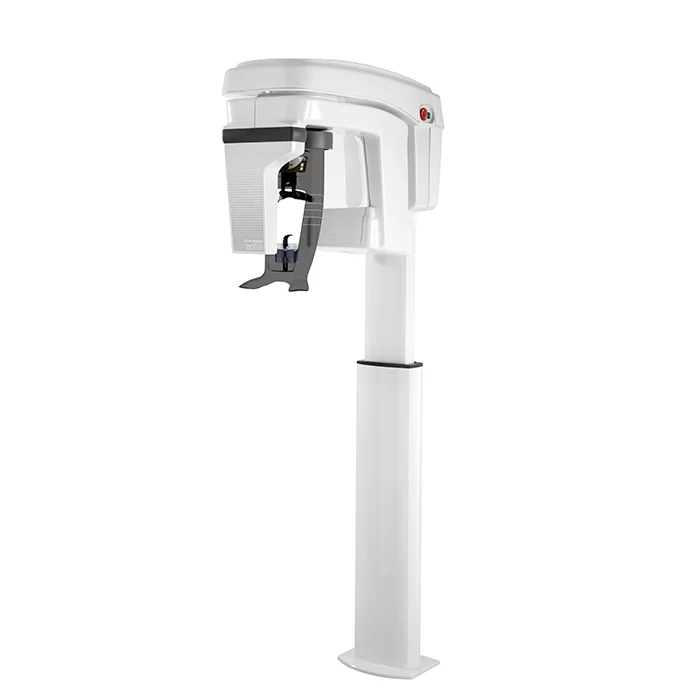
Five things that change the treatment plan — and are missed on a standard X-ray.
We do not use CBCT for every case. We use it when the standard image leaves a question unanswered — and that question matters.
- Vertical root fractures Cracked teeth
Cracks running along the length of the root are nearly invisible on standard X-rays — CBCT shows them clearly in three dimensions.
- Missed canals Retreatment
A tooth may have more canals than a standard X-ray reveals. Untreated canals are the most common reason root canal treatment fails. CBCT shows every branch.
- Extent of bone loss
A periapical X-ray shows a shadow around the root. CBCT shows exactly how much bone has been destroyed and in which direction — information that changes both the treatment plan and the prognosis.
- Root fractures from trauma Traumatic injuries
Impact injuries can fracture the root below the gumline with no visible symptoms. A standard X-ray frequently misses these entirely.
- Complex anatomy before surgery Apicoectomy
Before an apicoectomy, we map the root tip, the surrounding anatomy, and the path to it — so there are no surprises when we make the incision.
Accurate diagnosis is where good treatment starts. Not after the incision.
CBCT is not standard equipment at every endodontic practice. The investment reflects a commitment to knowing what we are treating before we treat it — not making assumptions from a flat image and hoping the anatomy cooperates.
Better diagnosis means fewer surprises during treatment, more accurate prognoses, and in many cases a clearer picture of whether a tooth can be saved at all. That clarity is not just clinical — it can save you from procedures that would not have worked.
"When Dr. O'Callaghan took new images right before the procedure, she found that a root had broken and the only option was surgery — which she performed right then and there. The surgical site healed well. The tooth now feels completely normal."
What patients ask about CBCT imaging.
- Do I need a CBCT scan for every procedure?
- No. Standard periapical X-rays are sufficient for straightforward cases. We use CBCT when the clinical picture is incomplete — when we suspect a crack, a missed canal, complex anatomy, or significant bone loss that a standard X-ray cannot fully reveal. The decision is always based on whether it will change the diagnosis or the treatment plan.
- Is the radiation from CBCT safe?
- Endodontic CBCT uses a small, targeted field of view — imaging only the specific tooth and immediate surrounding area rather than the full head or jaw. The radiation exposure is designed to be proportionate to the clinical need. We follow the ALARA principle: as low as reasonably achievable. We only recommend it when the diagnostic benefit outweighs the dose.
- Why can't a standard dental X-ray do the same thing?
- A standard periapical X-ray compresses a three-dimensional structure into a flat, two-dimensional image. Overlapping anatomy hides cracks, missed canals, and the true extent of bone loss. CBCT reconstructs a full 3D image of the tooth and surrounding bone from every angle — showing what a flat X-ray cannot.
- How long does a CBCT scan take?
- The scan itself takes under a minute. We review the images with you at the same appointment. For most patients, CBCT adds very little time to the visit — and significantly changes what we are able to see before making any treatment decision.
- Will my insurance cover a CBCT scan?
- Coverage varies by plan. Some dental insurance policies cover CBCT for specific clinical indications; others treat it as a separate item. We confirm your benefits before imaging. In many cases, the accurate diagnosis CBCT provides reduces the overall cost of treatment by avoiding unnecessary or repeated procedures.
Diagnosis before treatment. Every time.
Same-day access · Four East Bay locations · No referral required